
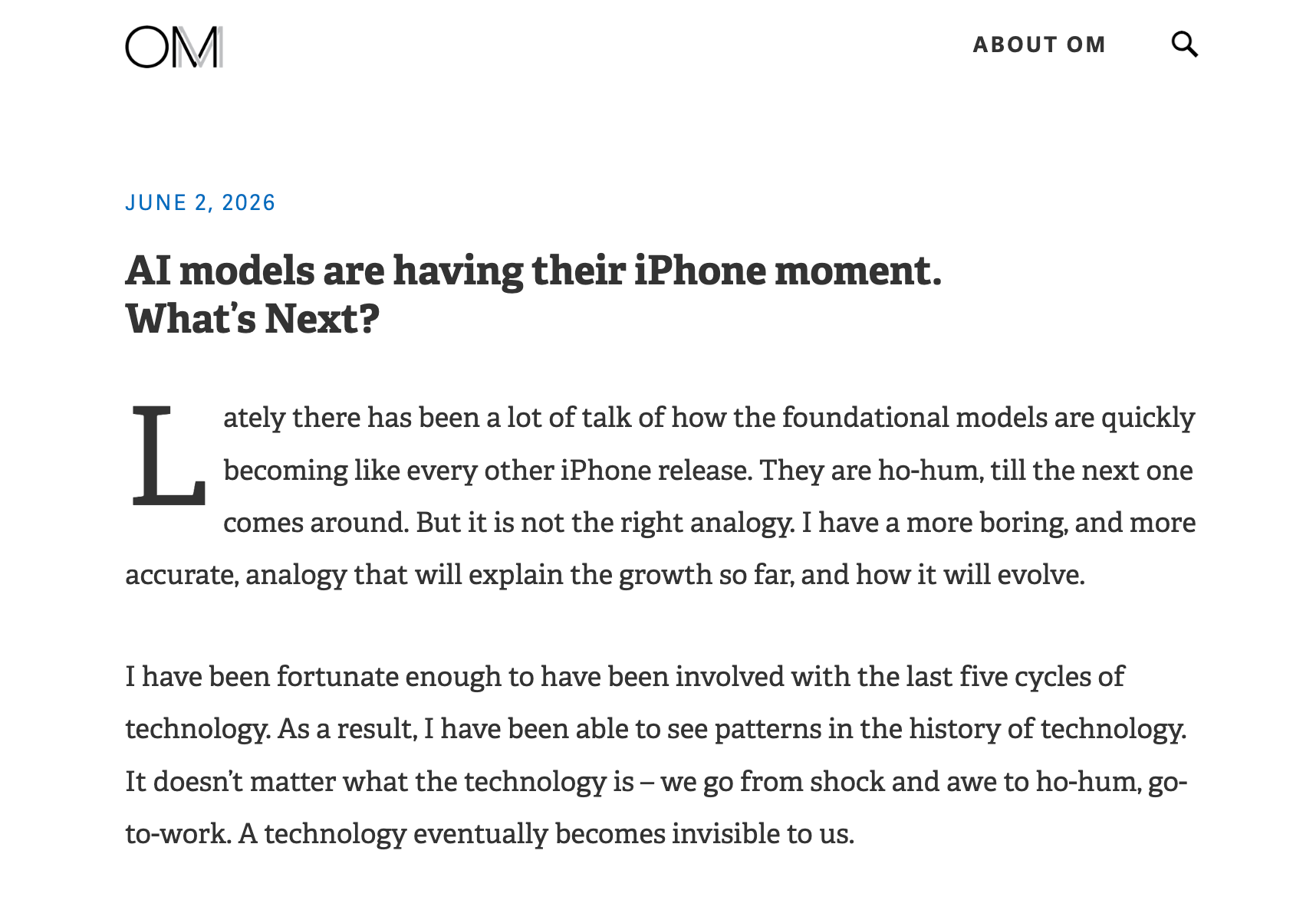
“AI will become the layer you cannot see that makes everything above it work… The models will not disappear. They will stop being the unit of conversation.” - OM
That line comes from Om Malik’s essay on AI models are having their iPhone moment. What’s Next?, and it has stayed with me since I read it last month. Om who recently passed away was one of those voices from the 2000's era, I remember watching him across from Leo Laporte explaining Silicon Valley to the rest of us in a way that made sense. He had a knack for seeing around corners in a way that made the future feel less like speculation and more like something already taking shape.
I think he was right, not just about the technology itself but about the way it will reshape how we experience the world around us. AI is technically already dissolving into the background of Austin, embedded in cars that drive us around town so we can continue working instead of watching the road, in Star Wars droid like food delivery services. Soon, no one will talk about “the model” in the same way no one talks about TCP/IP when they open a browser. It will just be there, quietly shaping everything without demanding our attention. Researchers and industry leaders now describe AI as the “invisible infrastructure” of modern life, when I first heard that I scoffed, but inside that framework you can see how like electricity or the internet, where it now operates seamlessly behind the scenes to enable activities we take for granted.
But there is a second order effect that feels under discussed a bit. The cost of building is collapsing in ways that make traditional startup capital less relevant than it used to be. Om’s piece points to this shift, noting that the real competitive advantage is moving away from foundation models toward applications that disappear into workflows and shape work whether anyone explicitly asks for AI or not. More and more founders will increasingly build companies without venture capital, combining lean operations, open-source tools, AWS credits, Bitcoin for payments, treasury, modern banking through Mercury, and distribution channels that did not exist a decade ago. We are entering a 10 to 15 year shift where software and robotics absorb large parts of what used to be industrial labor. NVIDIA CEO Jensen Huang has called AI “the largest infrastructure buildout in human history,” with value increasingly driven by the application layer built on top of massive investments in energy, chips, and cloud. Elon is also now speaking about this with exact certainty.
Even at the edges, you can see it forming in ways that feel both mundane and a bit unsettling. Here in Austin, a family member of mine working in a Tesla warehouse told me they are already shipping humanoid robots. The way he described seeing them for the first time stuck with me because it sounded like they were very expensive, fragile, and what he said buried in a coffin. Apparently, he was not even supposed to look inside the freight. For him, it made the future feel much closer than it had any right to be. At the same time, I have been spending more time around the AI x Bitcoin scene. Earlier this year, just before SXSW, PlebLab was apart of the AI Startup Rodeo where a surprising number of the companies that showed up were not venture-backed but were instead bootstrapped, lean, and in some cases, already profitable.
What separated them was not just the technology but the presence or absence of distribution, and a network to sell to, which has become the real constraint in a world where building is cheap but attention and gaining clients is not. Right now, both have become the bottleneck, and you either have it or you do not, and what founders do with it is another story entirely because some build real products while others drift into something stranger that people are starting to call “AI psychosis.” Sure it's a loaded term, but it points at something people are noticing and struggling to name, and while “AI psychosis” is not an official medical diagnosis yet, it refers to people breaking away from reality and experiencing delusions and hallucinations after interacting with an AI chatbot. Researchers have found that AI chatbots will sometimes encourage users’ delusional thinking because these systems are trained to be sycophantic, flattering and agreeable to keep users engaged even when that engagement pulls them away from shared reality.
Liminal Spaces

If Om is right, AI is not something we will keep noticing because it will fade into the background, into systems, tools, and environments that quietly shape our decisions. That is where this starts to get strange, because when something becomes invisible, you stop relating to it as a tool and start experiencing it as part of reality itself, which means the boundary between what is real and what is engineered begins to blur in ways that are hard to articulate. The closest analogy might be liminal spaces, and Backrooms is the obvious example, places that look complete and familiar but feel subtly off, structured but hollow, as if something essential is missing at the center. That feeling is what I am trying to describe how some people interact with AI.
People are talking to machines for hours, asking for advice, confessing things they would not tell anyone else, and in some cases forming attachments that feel real even though they are fundamentally one-sided. The interaction feels complete, coherent, and responsive, yet something is missing, and it is not immediately obvious what that missing thing is or how to name it without sounding like you are reaching for a metaphor that does not quite fit. Surveys show that one in four young adults believe AI could replace human-to-human romantic relationships, and one in ten is open to having an AI friend, which suggests that for a growing number of people the line between simulation and connection is becoming harder to see. Researchers warn that interacting with AI more than humans may reduce our ability to navigate complex human relationships over time, which means the drift is not just personal but cultural.
Existential Drift
If AI becomes the invisible layer of the world, then drift does not start as a philosophical problem but as a practical one, changing how decisions get made not all at once but gradually, in ways that will feel like improvement more than loss. You stop sitting with uncertainty as long because you can check the model, maybe you stop asking for help because you can just check the model, then you get to a point where you stop writing entirely because you can check the model. The dependency becomes real really fast and makes it hard to see, because the system is not just giving you answers but shaping how you arrive at them, the space where struggle, doubt, and contradiction used to exist, as much as those things, made us uncomfortable as they are, it helped how people formed judgment. AI being the overlords always there, always coherent, always ready to respond, so it becomes the easiest place to keep returning to. This feels eerily close to Childhood’s End. Not because it is more true, but because it asks almost nothing from you in return.
There is a line from Radiohead that feels relevant here, which is that just cause you feel it doesn't mean it's there, and when AI sits underneath everything, the interaction no longer feels like “using a tool” but like thinking, like reflecting, like being understood. An MIT Media Lab study noted that voice interactions with ChatGPT reduced loneliness for some, but experts warned that excessive use of these tools may worsen loneliness and erode social skills over time, which suggests that the drift is not just individual but systemic. Researchers at BYU surveyed Americans ages 18 to 30 and found that about 15 percent who are dating, engaged, or married regularly talk with AI chatbots to simulate a romantic partner, and that using AI companions is linked to lower relationship stability and a higher likelihood of breakup or divorce, which means the consequences are not just emotional but structural.
AI will be in every camera in your city, the hospital monitor that we take our last breaths from, the contract we are about to sign, the workflow we just invented this month, everywhere and nowhere all at once, and it will be incredibly useful, and in many places it will be good, but the interior structure cannot be built only from outside and outsourced because the self is still formed through reality, through struggle, patience, correction, forgiveness, and trust in other people. You still have to go through things, and you cannot simulate your way into becoming someone, which means that at best AI remains a tool and at worst it becomes a hiding place. And the real danger is not that people lose themselves everywhere all at once but that they slowly learn to avoid the hard parts of reality, one conversation at a time, one answer at a time, one private world at a time, until the boundary between tool and world, between simulation and relationship, becomes so thin that it no longer feels like a boundary at all.
There is no there there.
And still, people may begin to live there.
Christ says: “You will know the truth, and the truth will make you free” Of the words contained in the Gospel these are certainly among the most important. For they refer to man in his totality. They explain what the dignity and greatness proper to man are built upon from within, in the dimensions of the human spirit. The knowledge which frees man does not depend on education alone, even of university standard-an illiterate person can have it too; though education, the systematic knowledge of reality, should serve the dignity of the human person. It should therefore serve the truth. - Pope John Paul II