
I've been thinking about this idea around replica lately. Mostly because we are in the process of growing to another city and its good to put my brain power to things that are fruitful to others, so a lot of what has been in my mind is around these potential concept(s) I am trying to make sense of...
When something works in one place, how do you recognize whether it might work somewhere else, too? I'm not one for experimenting with time for that requires concreteness.
Replica, I don’t mean the game, an imitation, exactly or done out of ego perhaps but genuine replication.
Something more like recognizing an application that worked somewhere fitting and seeing if it holds true when you try it somewhere else. The closes I have seen this done in my life on repeatable offenses is around HEB, but we aren't exactly there yet, so something else is more than likely required.
I think this question has been following me longer than I realized.
Some of what we’ve done in Mexico replicates well +/- a few differences. Looking back that's basically how I ended up working in Bitcoin, through replication.
There’s a personal part of this story I don’t often share, but it helps explain how I found my way here. I dropped out of college early, and I’ve sometimes felt embarrassed about that, because I wasn’t there very long. I wouldn’t blame the school, or say I’m unable to learn in a "classroom setting." I’ve just always been drawn to learning about things I genuinely care about. I need to feel some passion or energy for what I’m doing and when I don’t, even knowing something is required doesn’t always make me want to do it.
In my twenties, I mostly followed my own interests and played in bands and side projects. When I moved to Austin, I helped organize parts of the local music scene with friends. Then came web design which I actually started much younger lol, cisco networking was a ton of fun to learn, and eventually writing about crypto and, later, Bitcoin. At the time I interviewed people building things, the good ole days of reviewing projects, and eventually started abc with my friends. PlebLab felt like a natural next step. and it all just reminded me of what I always had done was just replication. I just knew how to help friends do things that previously had application. Then it became something bigger, helping dozens of builders do things like start companies.
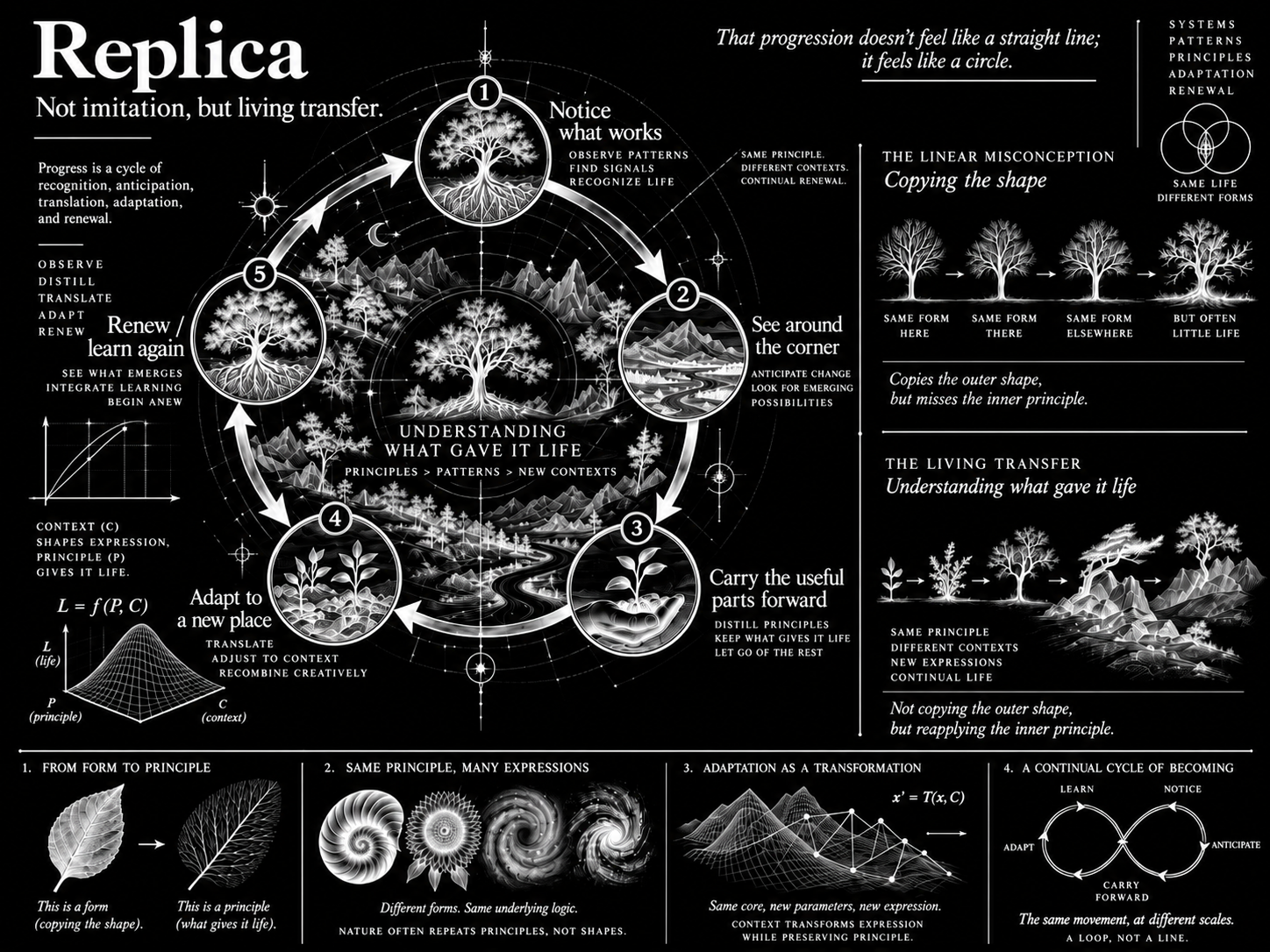
That progression doesn’t feel like a straight line, feels like a circle. Systems thinking played a big part in this, like noticing what works, seeing around the corner, carrying the useful parts forward, and adapting them to a new place. Maybe that’s what I mean by replica not copying the shape of something, but understanding what gave it life or provided that application.
And maybe that is why growing into another city feels less like starting over and more like being asked to understand what actually was applied through replication.
FF to this past month, and I’ve joined Decile Group’s Cohort 22 to learn how to start a fund. Even writing that sentence feels strange and weighty. Six years ago, when I started down this Bitcoin path, I never imagined I’d be here writing that sentence. I can’t share much about the program because of NDAs and other filings, but I can say it has opened my eyes to how much I still have to learn as a founder while also understanding the whole picture.
My favorite thing has also been a pleasure to talk with people who have also started communities, accelerators and venture studios. Hearing them describe the same “kill, copy, steal” challenges, the multiple "starts, stops" challenges, and the growing pains we've gone through at PlebLab has felt like a relief and validation for me. These things are hard, but they’re not only hard for us because we are in Bitcoin, thats an excuse I use, it's actually hard for everybody.
Some of the most valuable moments have come from discussions with general partners and people at large and medium size funds. Being able to ask honest questions and hear how they answer and think about the AI space has been eye-opening and at times a luxury. In some ways, their perspective feels familiar to me. A lot of people in Bitcoin have been wrestling with similar questions: What is changing? What matters? What might last? Where does it all go? I have some thoughts but more on that later.
The more I hear from people who have tried to carry something forward, the more I think replication asks for something beyond knowing the right model or playbook.
It asks for a way of showing up with people, especially when you do not yet know the whole picture.
Love is patient, love is kind. It is not jealous, [love] is not pompous, it is not inflated, it is not rude, it does not seek its own interests, it is not quick-tempered.
Aquinas reminds us that to love is “to will the good of the other,” but there’s a passage I heard recently again in 1 Corinthians 13 that reminded me of the exact same thing. Felt timely as well, Paul writes that love is patient and kind, does not insist on its own way, and bears, hopes, and endures all things. He also says in that same passage, that we know only in part, and that when I became an adult, I put away childish things.
Maybe growing into a new city, or learning how to build a fund, begins with admitting that what worked before is only part of what I know. The challenge is to carry it forward with the enduring Paul described, patience, humility, and enough love for the people involved to keep learning. That is likely concreteness, what is worth replicating?
Not the exact thing that worked somewhere else, but the Care it takes to learn what might work here.
All of October find me in PlebLab, next week I will be at TabConf 8 to do a live SNL, will also be at AI Startup Rodeo on the 30th at Q-Branch and at Capital Factory for Austin Tech Week that last week of October. If you see me say hi.
“For now we see in a mirror, dimly, but then we will see face to face. Now I know only in part; then I will know fully, even as I have been fully known." - St. Paul the Apostle.